Tag: OSINT

  • Social media profiling now costs sixteen cents a person

    Social media profiling now costs sixteen cents a person

    Table of contents

    Give an LLM pipeline a name and wait eight and a half minutes. Automated social media profiling then reports how someone writes, how careful they are online, where their career is heading and what they can reach at work.

    Most of that never appeared in a post.

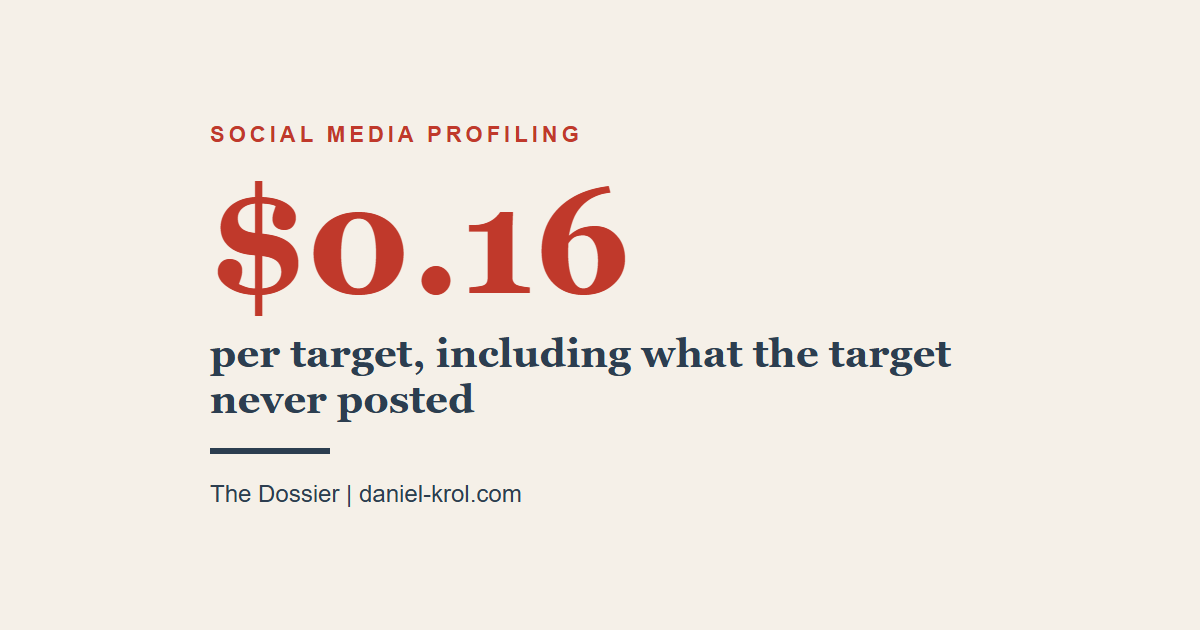
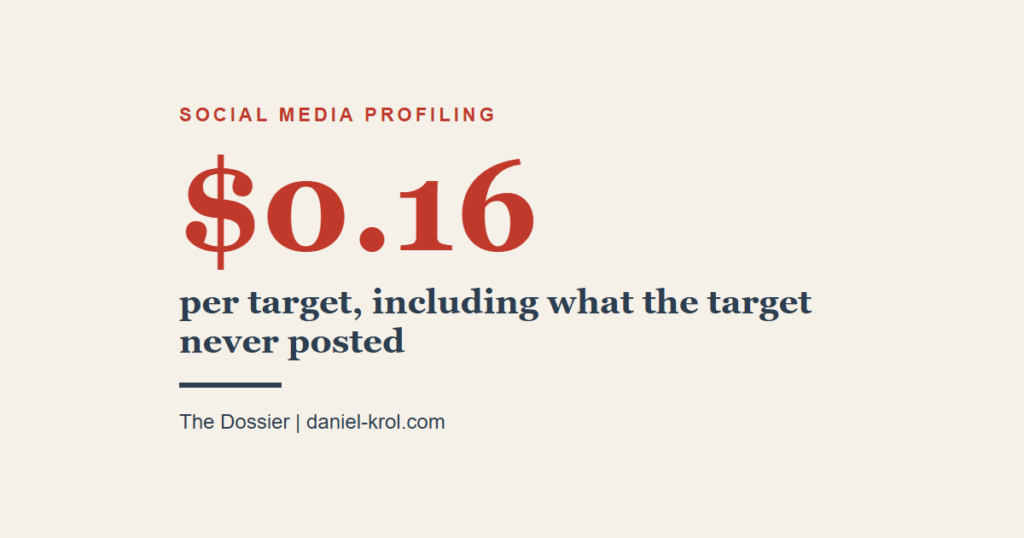
    The paper prices it at $0.16 per target, and the full range was 14 to 18 cents.

    Pellegrino Casoria and Simon Pietro Romano from the University of Naples Federico II tested social media profiling on 14 volunteers. They scraped LinkedIn and Facebook pages for each person and then asked that person to grade the profile the pipeline built.

    I read the sample description twice, because a security job and a weekly LinkedIn habit put me right in it.
    social media profiling

    All 14 volunteers were cybersecurity professionals with high privacy awareness, and they still gave the inferred attributes 4.73 out of 5.

    Your privacy settings don’t stop social media profiling

    Privacy settings control what you publish, and social media profiling works on what follows from it.

    The easy layer covers job titles and degrees, where extraction hit an F1 score of 97.3%. Regex managed 28.0% on the same data and spaCy’s entity recognition 17.3%.

    The harder layer holds OPSEC awareness and organizational access, and nobody typed either of those into a form. The model reasons across profile entries and fills them in. OPSEC awareness scored 4.79 and organizational access 4.57 on the targets’ own ratings. I saw the same blind spot in AI agent privacy, where access control covers who reads a record and skips what the model does with it.

    Neither baseline produced a single one of the 252 inferred attributes.

    The scraper captured up to ten recent posts, so the input was small.

    A February study by Simon Lermen and his co-authors showed LLM agents can work out who you are from anonymous posts. He warned that your city and your job add up, and his wording stuck with me. “The combination is often a unique fingerprint.” The Naples paper picks up where that study stops, because once the name is known, social media profiling costs less than a stamp.

    “Nothing to hide” looks at the wrong thing

    Most people judge exposure one post at a time, and on that view a conference photo or a new certification looks harmless.

    Attackers read the sum of those posts, and reconnaissance opens the kill chain. MITRE ATT&CK files the step under T1593.001, the social media branch of Search Open Websites/Domains. The paper points to Dream Job and Contagious Interview, two North Korean-linked campaigns that opened with fake personas on LinkedIn and other platforms before any technical intrusion.

    That step used to take a human analyst, and the authors now price social media profiling at under $20 for a hundred targets. Low-resource attackers, they write, gain “what once required well-funded operations.”

    Nobody got phished in this study, and the authors say so. The team measured a proxy, where each volunteer ranked four options on 12 questions and the system predicted the ranking.

    Agreement came out moderate, with Kendall’s tau at 0.36 and the first choice landing about 52% of the time. That is double the random baseline, and all 14 volunteers scored above zero, thin footprints included.

    So read “susceptibility” here as picking the right pretext, which is the step an attacker has to get right first.

    What changes for your security team

    Communication scored highest at 0.54, ahead of Career at 0.30. Interests came last at 0.23, and that split is the part of this social media profiling study I would show a security team.

    Your tone and your disclosure habits stay stable across posts, so the model reads them best. My reading is that this weakens the old phishing tell of a message that sounds off. If the wording matches how your team talks, style stops being evidence.

    So check the request itself, and confirm anything about money or credentials through a second channel, whoever appears to be asking.

    Picture a firm with 500 staff, where about $80 lets an attacker run social media profiling on everyone. A sort by organizational access and OPSEC awareness then picks the five people with the most reach and the least caution. That scenario is mine, and the per-target price behind it comes from the paper.

    How social media profiling works, and where it falls short

    The design goes by “dumb scraper, smart LLM” in the paper, with Playwright fetching raw pages through session cookies. Extraction runs on gpt-4o-mini and profiling on gpt-5-mini, while gpt-5 handles engagement. Layout changes barely touch the scraper, so maintenance stays cheap.

    Session cookies also change what “public” means, because the pipeline sees whatever any logged-in user sees.

    The sample is 14 people from the authors’ own network, and coverage stops at two platforms and a single snapshot. The grades are self-reported, and 29% of participants flagged incorrect data. The richest profile scored worst, at 84.1%.

    I read this as a pilot that proves the price and the feasibility. How many people would click is still an open question.

    Run social media profiling on yourself first

    Take your last ten public posts and give them to a local model. Ask what it can tell about your access at work and how it would approach you.

    Whatever comes back and makes you uncomfortable is your exposure.

    The test won’t show what an attacker adds from breach data, and deleting a post does nothing about copies already scraped.

    Assume someone has read your last ten posts, because at sixteen cents they can afford to.

    Source | https://arxiv.org/abs/2610.31573


    Want More? Subscribe to The Dossier

    Every week in your inbox:

    📡 THE INTELLIGENCE FEED – 3-5 curated links: [Research] [Policy] [Tools] [Incidents]
    💡 ONE ADVICE – One actionable AI/cybersecurity tip you can use today

  • The End of Online Anonymity

    Table of contents

    You might think your online anonymity is bulletproof when you post a comment on Hacker News under a fake name complaining about a new JavaScript framework. On a horror movie subreddit, you rant about a terrible ending. Somewhere on an old, forgotten forum, you mention the strong wind during your morning train commute. You feel like a ghost. Nobody will connect these dots. Why would they?

    Wrong.

    It has just been proven that this scattered trail is more than enough. Machines have learned to play detective, and your long-held online anonymity just evaporated in a fraction of a second.

    The End of Practical Invisibility

    For years, mathematics and human laziness protected us. Sure, intelligence agencies could track you down. But why would they waste time on an average person? It required a human being who would sit down, read your posts, take notes, and tediously search through multiple databases. The labor costs of a human investigator formed a natural, invisible shield.

    That shield has turned to dust.

    Simon Lermen and researchers from ETH Zurich and Anthropic tested something terrifyingly simple and effective. They connected large language models to the internet and let them play at profiling. Autonomous artificial intelligence agents analyzed loose text, randomly thrown sentences, and pseudonymous user accounts. Then, they found the real names, surnames, and professional resumes of those users.

    They did this without structured data from spreadsheets. They only used the thoughts we mindlessly type out in posts and comments.

    Why You Live in a Security Illusion

    You are probably thinking right now: “I never use my real name. I always use a VPN. I have separate emails and usernames for every single forum.”

    Many people believe that online anonymity relies entirely on hiding their first and last name. That does not matter at all. We assume that if we delete our date of birth and phone number, we become invisible. This is a fatal misjudgment. We forget that our identity is actually the sum of thousands of tiny habits, opinions, and daily micro-events.

    online anonymity

    Artificial intelligence is not looking for your ID card. It is looking for your unique behavioral pattern. True online anonymity requires a complete erasure of your lifestyle footprint.

    Imagine a specific scenario. You write on a forum about a PostgreSQL database crash at 2:00 AM Central European Time. Two months later, on a restaurant review platform, you give a one-star rating to a cafe on Florianska Street in Krakow, adding that “the espresso was sour.” The machine connects these two facts. It knows you are a programmer from Krakow who works late nights. If someone from Krakow posts on LinkedIn at the exact same time about a “rough night patching the database,” the system has 99% certainty it is you.

    No human could process millions of accounts to catch this one tiny pattern. For a machine, it takes 14 seconds. People mistakenly believe that the giant noise of information protects their online anonymity. Meanwhile, for large language models, this noise is a massive, highly readable barcode with your name on it.

    The Price of Your Secrets is a Cup of Coffee

    Let us move to the second-order effects. Since the cost of deanonymizing a single profile has dropped to just four dollars, all the old rules no longer apply. Complete online anonymity used to be a barrier against mass surveillance. That barrier has vanished.

    Employee Background Checks

    An employer can throw your polished, official resume into the system and order the algorithm to find all your pseudonymous accounts on Reddit or other message boards. They will do this preventatively, for thousands of candidates a day. They will check if you express views in your free time that could harm the company’s image. The cost of vetting 100 candidates will be less than a recruiter spends on lunch.

    Insurance and Health Premiums

    An insurance company will effortlessly link your struggle with a chronic illness, described on support forums, to your official professional profile. Then, the system will automatically raise your health premium by 30%. You will argue, but you will only hear a rehearsed corporate script about “risk calculation.”

    Precision Hacking Attacks

    Criminals no longer need to mass-email poorly translated scams from Nigerian princes. Instead, they will commission machines to build a database of thousands of wealthy individuals hiding behind cryptonyms on cryptocurrency forums. The criminal asks the model for a list of people complaining about specific bugs in a Trezor hardware wallet.

    Then, the system sends them messages pretending to be official support, quoting the exact bugs they wrote about under fake usernames. The success rate of such an attack jumps from a fraction of a percent to dozens of percent.

    Blackmail on an industrial scale becomes cheap and readily available. Your deepest secrets just got an official price tag.

    How Machines Connect the Dots (Step by Step)

    How does this deanonymization work under the hood? Traditional online anonymity relied on data siloing, but algorithms can bridge those silos perfectly. There is no magic here. It is pure, ruthless deduction.

    1. Data Extraction: The agent reads your chaotic comments and builds a detailed profile. It records your age (inferred from a joke about VHS tapes), favorite neighborhoods, and complaints about specific coding errors.
    2. Query Generation: The system creates a series of search queries based on these fragments. It ignores usernames. It searches for combinations: “Python developer” + “Krakow” + “road bike”.
    3. Autonomous Hunting: The algorithm gets full access to a search engine. It digs through the results, analyzes them, and compares them with your profile.
    4. Probabilistic Analysis: The model calculates the odds. If there are 100,000 programmers in Poland, but only 50 use the Elixir language, and only one of them recently mentioned buying a specific model of a bicycle helmet, the pool of suspects shrinks to exactly one person.

    Active Disinformation is Your Only Defense

    Since passive online anonymity is a thing of the past, you must change your tactics. Hiding does not work anymore. Deliberately creating chaos does.

    • Poison your data: Change irrelevant details in your stories. If you are 32 years old, write on a forum that you are 38. If you have a daughter, mention that you need to pick up your son from kindergarten.
    • Modify your writing style: Your unique linguistic fingerprint is a death sentence. Use tools and simple scripts to rewrite your posts before publishing, removing your specific linguistic habits.
    • Create false geographical trails: Do you mostly comment on events from London? Throw in regular complaints about traffic in Manchester and the weather in Scotland.

    Practical invisibility has died. If you want to maintain your online anonymity, start actively lying to the machines. Otherwise, accept the fact that every single digital whisper you make has already been permanently attached to your real name.


    Want More? Subscribe to The Dossier

    Every week in your inbox:

    📡 THE INTELLIGENCE FEED – 3-5 curated links: [Research] [Policy] [Tools] [Incidents]
    💡 ONE ADVICE – One actionable AI/cybersecurity tip you can use today