Table of contents
Give an LLM pipeline a name and wait eight and a half minutes. Automated social media profiling then reports how someone writes, how careful they are online, where their career is heading and what they can reach at work.
Most of that never appeared in a post.
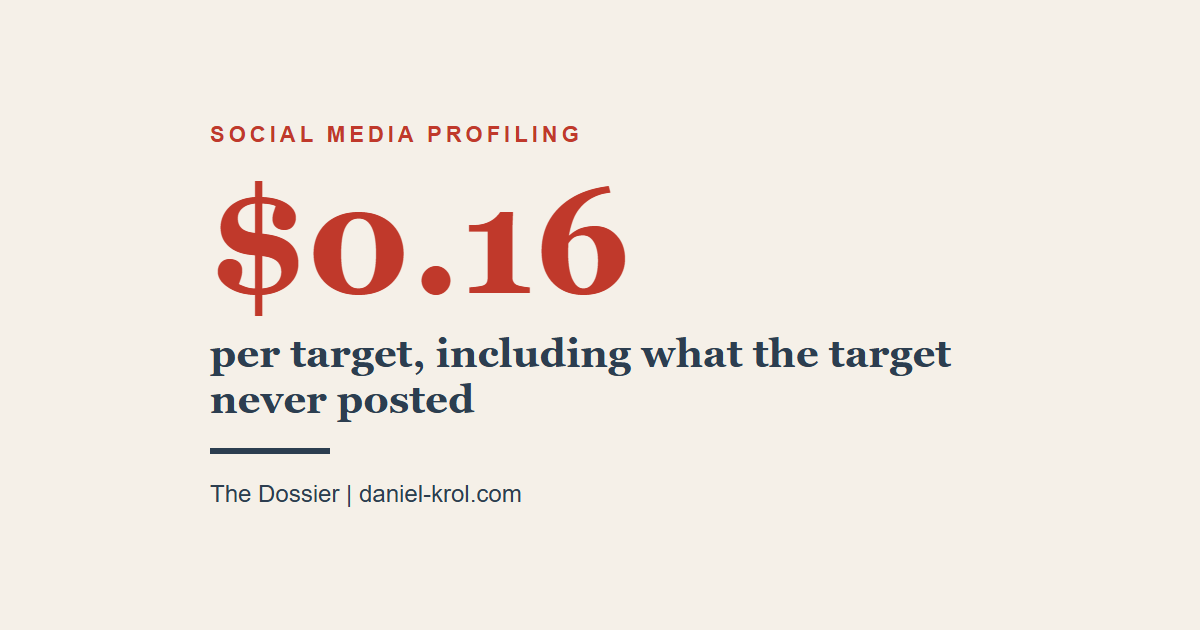
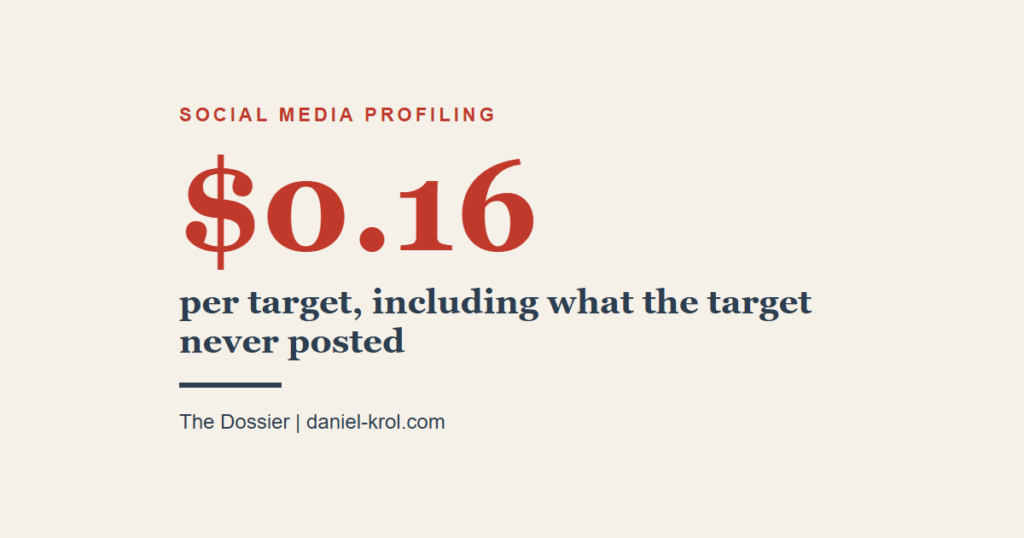
The paper prices it at $0.16 per target, and the full range was 14 to 18 cents.
Pellegrino Casoria and Simon Pietro Romano from the University of Naples Federico II tested social media profiling on 14 volunteers. They scraped LinkedIn and Facebook pages for each person and then asked that person to grade the profile the pipeline built.
I read the sample description twice, because a security job and a weekly LinkedIn habit put me right in it.
All 14 volunteers were cybersecurity professionals with high privacy awareness, and they still gave the inferred attributes 4.73 out of 5.
Your privacy settings don’t stop social media profiling
Privacy settings control what you publish, and social media profiling works on what follows from it.
The easy layer covers job titles and degrees, where extraction hit an F1 score of 97.3%. Regex managed 28.0% on the same data and spaCy’s entity recognition 17.3%.
The harder layer holds OPSEC awareness and organizational access, and nobody typed either of those into a form. The model reasons across profile entries and fills them in. OPSEC awareness scored 4.79 and organizational access 4.57 on the targets’ own ratings. I saw the same blind spot in AI agent privacy, where access control covers who reads a record and skips what the model does with it.
Neither baseline produced a single one of the 252 inferred attributes.
The scraper captured up to ten recent posts, so the input was small.
A February study by Simon Lermen and his co-authors showed LLM agents can work out who you are from anonymous posts. He warned that your city and your job add up, and his wording stuck with me. “The combination is often a unique fingerprint.” The Naples paper picks up where that study stops, because once the name is known, social media profiling costs less than a stamp.
“Nothing to hide” looks at the wrong thing
Most people judge exposure one post at a time, and on that view a conference photo or a new certification looks harmless.
Attackers read the sum of those posts, and reconnaissance opens the kill chain. MITRE ATT&CK files the step under T1593.001, the social media branch of Search Open Websites/Domains. The paper points to Dream Job and Contagious Interview, two North Korean-linked campaigns that opened with fake personas on LinkedIn and other platforms before any technical intrusion.
That step used to take a human analyst, and the authors now price social media profiling at under $20 for a hundred targets. Low-resource attackers, they write, gain “what once required well-funded operations.”
Nobody got phished in this study, and the authors say so. The team measured a proxy, where each volunteer ranked four options on 12 questions and the system predicted the ranking.
Agreement came out moderate, with Kendall’s tau at 0.36 and the first choice landing about 52% of the time. That is double the random baseline, and all 14 volunteers scored above zero, thin footprints included.
So read “susceptibility” here as picking the right pretext, which is the step an attacker has to get right first.
What changes for your security team
Communication scored highest at 0.54, ahead of Career at 0.30. Interests came last at 0.23, and that split is the part of this social media profiling study I would show a security team.
Your tone and your disclosure habits stay stable across posts, so the model reads them best. My reading is that this weakens the old phishing tell of a message that sounds off. If the wording matches how your team talks, style stops being evidence.
So check the request itself, and confirm anything about money or credentials through a second channel, whoever appears to be asking.
Picture a firm with 500 staff, where about $80 lets an attacker run social media profiling on everyone. A sort by organizational access and OPSEC awareness then picks the five people with the most reach and the least caution. That scenario is mine, and the per-target price behind it comes from the paper.
How social media profiling works, and where it falls short
The design goes by “dumb scraper, smart LLM” in the paper, with Playwright fetching raw pages through session cookies. Extraction runs on gpt-4o-mini and profiling on gpt-5-mini, while gpt-5 handles engagement. Layout changes barely touch the scraper, so maintenance stays cheap.
Session cookies also change what “public” means, because the pipeline sees whatever any logged-in user sees.
The sample is 14 people from the authors’ own network, and coverage stops at two platforms and a single snapshot. The grades are self-reported, and 29% of participants flagged incorrect data. The richest profile scored worst, at 84.1%.
I read this as a pilot that proves the price and the feasibility. How many people would click is still an open question.
Run social media profiling on yourself first
Take your last ten public posts and give them to a local model. Ask what it can tell about your access at work and how it would approach you.
Whatever comes back and makes you uncomfortable is your exposure.
The test won’t show what an attacker adds from breach data, and deleting a post does nothing about copies already scraped.
Assume someone has read your last ten posts, because at sixteen cents they can afford to.
Source | https://arxiv.org/abs/2610.31573